

Has ‘super clipping’ ruined F1’s most challenging corners?
F1's new cars have produced great racing, but have compromised one area that makes it spectacular. Drivers and fans are urging technical chiefs to find a solution after seeing the effects in Suzuka.

As part of their preview content for this weekend’s Japanese Grand Prix, Formula 1 posted a video on social media with the title: “These moments at 130R are CRAZY!”
Suzuka’s 130R is one of F1’s most challenging corners.
Located in the final part of the lap, immediately after the cars cross over the figure eight section, they are presented with a ruthless left-hander that is approached at close to 200mph.
Fernando Alonso produced one of F1’s best overtakes on Michael Schumacher in 2005, while former drivers Allan McNish and Jaime Alguersuari have both shown how wrong it can go if you make a mistake.
After two hours of practice, it’s pretty clear we won’t be getting any similar ‘crazy’ moments in 2026.
This is largely due to an inherent problem with this year’s power unit regulations, which is mainly exposed at circuits where the battery, accounting for 50% of the total power output, is starved of energy.
Despite the FIA's attempts to mitigate it, the question arises: have classic corners that have defined the good and the great in F1 now been castrated?
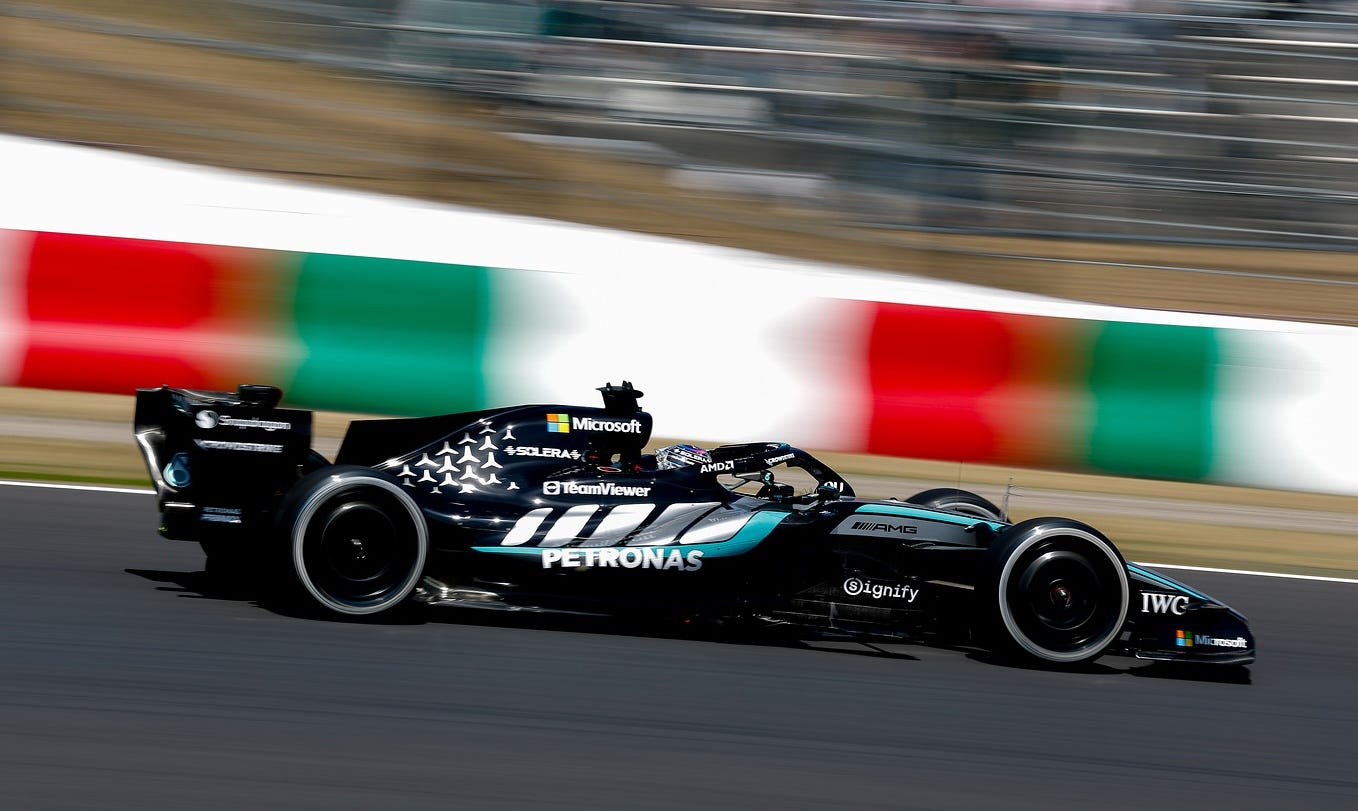
FIA makes last-minute rule tweak at Suzuka
In the hours leading up to the first practice session for the Japanese Grand Prix, the FIA made a last-minute rule change to qualifying.
The tweak centres around Formula 1’s complex energy management rules. Although the standard recharge limit for the 4MJ (megajoules) battery is 8.5MJ, the FIA varies that allowance at each circuit on safety grounds.
This was introduced amid suggestions that drivers would employ erratic tactics, such as lifting and coasting on straights, to recover maximum energy.
As outlined in the technical regulations, the governing body can reduce the recharge from the standard 8.5MJ to as low as 5MJ when “harvesting strategies required to achieve the above limit are excessive.”
The regulations also give them the freedom to increase the limit to 9MJ at tracks where energy recovery is easy and extra power is beneficial.
Suzuka had been highlighted as one of the venues where a 9MJ allowance would be permitted because of the lack of heavy-braking zones where batteries can be easily recharged.
But in their Power Unit Information document issued on Thursday, the FIA stipulated that only 8MJ of harvesting would be permitted, down from the planned 9MJ.
A separate statement confirmed that the rule changes received “unanimous” support from power unit manufacturers and were done to “ensure that the intended balance between energy deployment and driver performance is maintained.”
That balance specifically refers to super clipping, where the power unit switches to a mode that enables the battery to draw power from the Internal Combustion Engine to charge. The effect was present in the previous set of regulations, although not as prominently, and was often referred to as battery de-rating.
Concerns have grown over the spectacle in qualifying ever since the scene of drivers losing as much as 50kph on entry to the high-speed Turns 9 and 10 at Melbourne exposed a weakness in the current regulations.
Normally, a corner where drivers change down two gears and flick the car left, then right, at around 180mph; instead, they were taking it 40mph slower, as the car had already begun to slow down due to the super clipping.
This was less of an issue at Shanghai because of the amount of heavy braking zones, but the problem has reared its head again at Suzuka.
Has Suzuka been spoiled?
This high-speed circuit is one of the scariest on the calendar, largely because of the proximity of the barriers to the tarmac.
Four-time world champion Sebastian Vettel once said it was the only circuit he would seriously consider making a comeback, explaining that it was the track where he felt most “alive” when racing.
Alex Albon pointed out three key areas that would be less exciting due to the need to lift and coast on entry in 2026: Degner 1, Spoon Hairpin, and 130R.
“There isn’t really any high-speed any more. Because you’re arriving so slowly, basically everything is a medium-speed corner now,” he added.
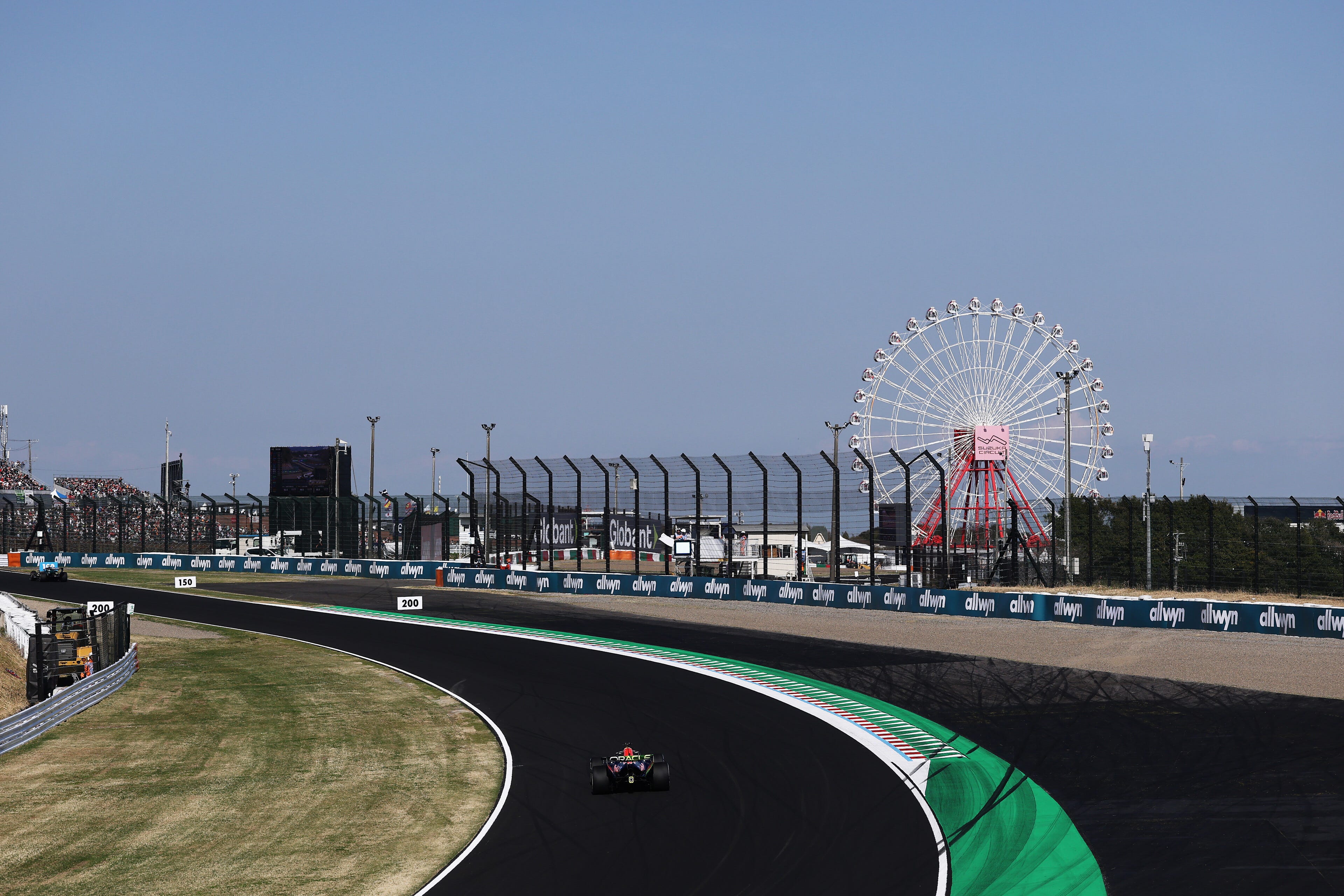
Watching laps from both practice sessions, it was clear these were pinch points for F1’s energy-starved power units.
It’s more subtle on the entry to Degner 1 and Spoon, but the drivers are losing speed before they apply the brakes at corners that often generate mistakes. This was the case in the quickest laps by Oscar Piastri, Andrea Kimi Antonelli, and Max Verstappen in FP2.
Speaking at the Thursday press conference, Lando Norris highlighted how Spoon used to demand full commitment from drivers on entry, as they hook the car into the sweeping left turn that mimics the household cutlery item.
“You’ll start [super] clipping into Spoon. That’s one of the quickest corners, where you turn in, and you are going incredibly quickly. Like last year, I didn’t even brake on entry to Spoon,” said Norris.
“It took a risk to get to that point, and it feels incredible in Quali when you’re pushing it to the limit like that.”
Esteban Ocon also pointed out that this year’s cars have much less downforce than in 2025, which contributes to slower speeds, but admitted it was a “shame” that the Degners had become “power-limited” rather than “grip-limited.”
Super clipping is mostly visible at 130R. Antonelli reaches a peak of 205mph midway down the straight between Turn 14 and 15, before gradually tapering down to 181mph as he reaches the apex of the left-hander.
Verstappen’s Red Bull starts super clipping much later, but then he loses a lot of speed exiting the final chicane. Piastri is much more gradual like Antonelli, with him only peaking at 195mph midway through the curved section before dropping to 180mph at the apex.
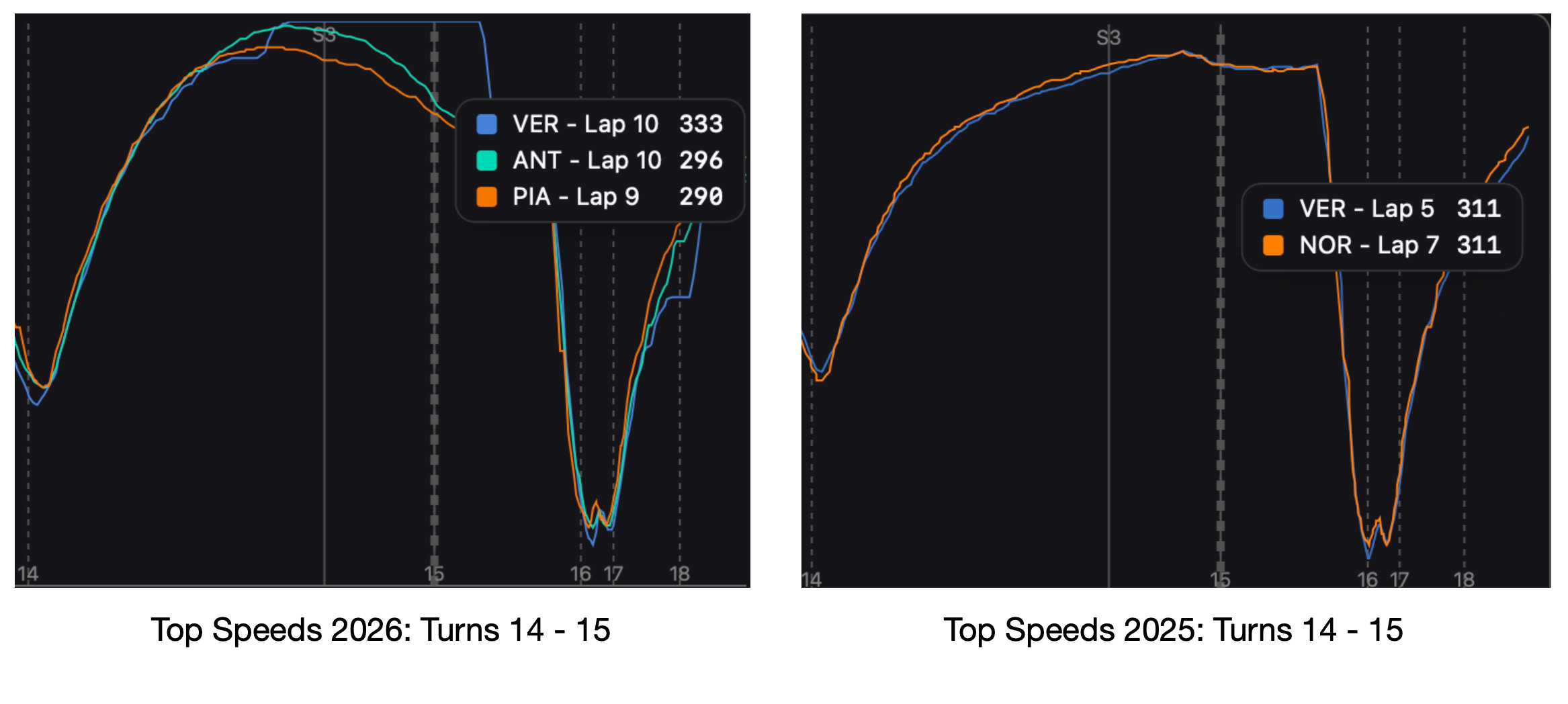
Compared to last year in the same session, Verstappen and Norris reach a peak of 196mph and drop to just 193mph at the apex of 130R.
When asked about whether F1’s battery deployment rules had ruined Suzuka, Norris answered: “It’s never ruined. I don’t think you can ever ruin this track. Will it be as spectacular? I don’t think so. It will not be.”
Spectacular has always been a non-negotiable for F1. It’s why the cars look like they do, spark as they do, and sound like they do.
Although the current regulations have delivered some exciting racing moments, the challenge of pushing to the limit on a qualifying lap should not be a compromise.
It’s a factor that Leclerc admitted has been lost in the quest to make F1 more accessible to manufacturers with simplified power units.
“What I love about this sport is when you get to Q3, and you have the maximum pressure on you to deliver at your best at that moment, and that you try and do a lap that you haven’t done before,” said Leclerc. “At the moment, this is not possible.”
F1 technical chiefs have been tasked to find a longer-term solution that can be implemented as early as the Miami Grand Prix to prevent energy management tactics from taking over the show.
What is clear is that there is a range of options available, whether it’s reducing the battery power output and compensating with more power from the internal combustion engine, or upping the fuel flow rate in qualifying only.
Whatever the solution, one of the core elements of F1’s DNA is being tested. Hopefully, something can be sorted out to bring back the thrills of qualifying.
F1 is supposedly the peak of motor racing and it should be at the cutting edge of technology, but it fails if you need a degree in Applied Mathematics & Physics to understand these new generation cars. I have been an avid F1 fan since 1975 and I consider myself quite intelligent, but it is so difficult to understand how the half and half Battery/ICE works during a race. The overtaking is great to watch but ultimately it is false because of the using and recharging of the Battery during the race, or is Driver A passing Driver B because of superior skills or using up his Battery? In which case Driver B will pass him easily at the next corner. F1 was the best, but I feel that this is the wrong way to go.