

What we learned from F1’s rookie outing in Mexico
Nine rookies took part in the FP1 session at Mexico. But why this track, and what do the results tell us about their futures in Formula 1?

Nearly half of the regular Formula 1 drivers made way for rookies in FP1 in Mexico, as teams fulfil the requirement to give up at least four slots this season for new talent.
This was expanded for 2025 from two to four FP1 outings, to give inexperienced drivers more time behind the wheel and the ability to build up superlicence points.
Most of the teams chose Bahrain earlier in the season because of the extensive running they did during pre-season testing. But why is Mexico such a popular destination?
With it being Round 20 of this 24-race calendar, most of the teams have already reached the end of their car upgrade cycles, so there is less to learn compared to other races.
It’s also the most ideal in terms of weekend format. Sprint weekends are a no-go because there is just one practice session, and with Qatar and Brazil still left to run, both Mexico and Abu Dhabi tend to be favourable.
The latter of those two also has an FP1 session that takes place during the daytime, which isn’t that relevant to the key running that takes place under the lights, and is also the venue of the post-season rookie test.
Mexico is also one of the highest circuits on the calendar. At 2,240 meters above sea level, it has 20% less oxygen compared to other races. The reduced air density means aero set-up isn’t such a big challenge, with Aston Martin’s Jak Crawford explaining: “The thinner air at altitude means there’s less aerodynamic load and downforce, so we run a high-downforce setup to compensate for that as much as possible.”
The low-grip conditions also play a factor, with track evolution playing a major role in extracting lap time around the Mexico circuit. Having a load of rookies ‘clean’ the track while also trying to impress future team bosses is effectively a win-win scenario, so long as nobody crashes.
That was almost the case between McLaren’s Patricio O’Ward and Red Bull’s Arvid Lindblad, with the latter receiving a warning from the FIA stewards after the session for impeding. O’Ward had to avoid Lindblad, who was coasting after a run at the high-speed Turn 9 and didn’t pay full attention to his engineer’s instructions.
This was also complicated by the fact that teams had reduced GPS and no onboard coverage due to a FOM system outage, making it even more difficult to judge traffic. It was a near-miss for Red Bull and McLaren that was avoided, although, could you imagine two of the main title protagonists’ cars being involved in an FP1 shunt?
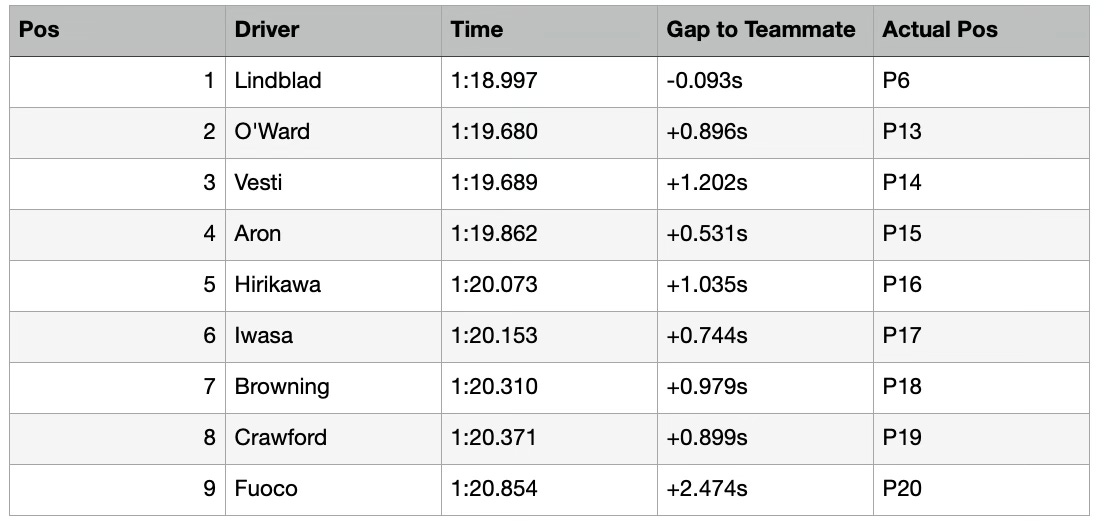
It was a competitive session for Lindblad. Substituting for Max Verstappen, the British talent clocked up 26 laps and beat Yuki Tsunoda’s best time by 0.093s to go sixth fastest. When you consider this is only Lindblad’s second outing in the RB21, it was an impressive outcome for the Red Bull rookie currently racing in Formula 2.
“Going into the session, I was quite nervous,” said Lindblad when speaking to F1 TV. “Obviously, also because of the situation we’re in at the moment with the championship and stuff, so it was even more important not to make any mistakes or do any damage. I focused on just trying to keep it clean and give good feedback. Also, to be towards the top of the timesheets.”
Red Bull remained tight-lipped on whether Lindblad’s performances this year have put him in contention for a seat in 2026, although it’s worth noting that he does currently qualify for a superlicence after being granted special dispensation from the FIA earlier this year.
Ayumu Iwasa was the other Red Bull driver substituting for Liam Lawson, although his ties to the Milton Keynes squad are similar to Tsunoda’s in that he is mainly funded by power unit supplier Honda, who will be switching to Aston Martin next season. He finished the session 17th quickest and half a second off Isack Hadjar.
Paul Aron is the next hopeful eyeing a seat as early as 2026, having substituted Pierre Gasly at Alpine. There has been increased scrutiny on Franco Colapinto in recent races, and ignoring team orders in Austin was never going to earn him any plaudits.
Both Alpine drivers went out towards the end of the session on the soft tyre, with Colapinto going 0.531s quicker than Aron. It was an important statement from the Argentine, considering he has yet to put in any spectacular results that could guarantee his spot for 2026.
O’Ward was the second quickest ‘rookie’, having finished in P13, although his experience in top-level single-seaters is considerably higher than his FP1 counterparts, coming off the back of challenging for this year’s IndyCar title.
In a way, it was somewhat disappointing to see O’Ward outside of the top ten. Especially when Norris jumped into the car in FP2 and instantly went faster than Piastri.
When asked about the importance of O’Ward’s contributions this weekend on Thursday, Piastri replied: “There are definitely things we can learn with Pato. It’s always another perspective in terms of driving the car. Ultimately, we can keep working on things with the car with Pato as well. How important is Mexico for the title aspirations? As important as the remaining four other races this year.”
Haas’ Ryo Hirakawa was 16th fastest, ahead of Williams’ Luke Browning in 18th. He didn’t get a run on the soft tyre, but was quickest of the rookies on the hard tyre early in the session. The Williams driver later said that this run was a “little bit of fun” and a “reward” for having a good F2 season, in which he is still in contention for the title with two weekends left.
Browning finished ahead of the main F2 title rival Crawford, who participated in his first official F1 session with Aston Martin. Crawford is billed as the next talent emerging from America, following Logan Sargeant, and gave some hint into his plans for the future: “I’m excited for the end of the F2 season, but also excited for my future. This will be my last year in F2, so I’ll hopefully be around this paddock more.”
Mercedes regular Frederik Vesti substituted George Russell at the Silver Arrows, with the Briton finding time to watch the cars trackside in the arena section by cosplaying as Rey Mysterio as a disguise. Mercedes has secured the futures of Andrea Kimi Antonelli and Russell with contract extensions through 2026, although Vesti remains a reliable test and reserve driver.
Ferrari chose to run Antonio Fuoco instead of F2 hopeful Dino Beganovic or recent F3 champion Rafeal Camara. It was a momentous occasion for Ferrari as it was the first time an Italian driver had driven one of their cars on an F1 weekend since Giancarlo Fisichella in 2009.
Team principal Fred Vasseur said it was all about giving Fuoco a reference for their simulator: “He’s not a proper rookie. He’s one of our reference drivers on the Hypercar, he won Le Mans, and he’s spending a lot of time with us in the simulator. This is the best occasion to give him time on track.”